

In 2016, at my startup Freckle, I had a bad feeling about buying Salesforce at every step. When my new head of sales asked for it. When their salespeople came to our office, looking out of place and making no sense. When I learned what an implementation involves. When the quote came in at $25,000 - for four sales reps, and software to write down who they’d called. Alarm bells everywhere.
But it didn’t feel like I had a choice, because I didn’t.
I’m definitely not alone. Put Salesforce head to head with its rivals on G2, across tens of thousands of reviews, and it loses on ease of use, ease of setup, ease of administration, and quality of support - while winning on “meets requirements.” That gap between hated and bought is the whole puzzle: 25 years x 150,000 customers didn’t happen by mistake, and that type of dissonance always points at something interesting.
The differential
The most instructive way to understand Salesforce’s stranglehold in the market is to contrast it with Microsoft Dynamics (fellow tech behemoth) and HubSpot CRM (challenger).
Microsoft has a bigger sales force, a bigger brand, way more power to bundle with software their customers already use, and it’s cheaper as part of that bundle. All with infinite resources. And Dynamics still can’t crack it.
HubSpot built a better product, paired it with a market leading marketing platform, and even got a good portion of the SMB market, but remains boxed out of the enterprise.
Infinite resources can’t do it, a better product can’t do it. The thing they both keep running into is worth naming.
Dual network effects
A strong network is a time-honored way to build staying power, but software like CRM doesn’t obviously lend itself to a network - each marginal company using the same CRM shouldn’t make it any more valuable for the other customers using it.
But Salesforce managed to build not just 1, but 2 networks on that fallow ground. When you buy Salesforce, you add to the world of people who put Salesforce on their resume as a skill. You pay contractors who make their living on Salesforce. You make Salesforce part of your recruiting pitch. Salesforce’s own commissioned research brags its ecosystem will have created 9.3 million jobs by 2026 - discount the vendor math by half and it’s still a labor market the size of a small country.
And then, you start using other software with Salesforce. You demand new software you use integrate with Salesforce. The result is AppExchange: about 6,200 apps from 3,700 developers, and 91% of Salesforce customers run at least one.
Salesforce repeatedly abuses these customers, too. August 2023 brought giant price increases. August 2025, another price increase, this time crediting AI. And the standard order form carries an annual uplift clause of 8-10% that compounds on whatever rate you negotiated. Each increase is described as reflecting innovation. The innovation is in the increases. A company setting its own brand on fire every year, and it just doesn’t matter - the dual networks are too much power.
That’s what was actually happening in my office in 2016. My head of sales wasn’t evaluating software - they arrived already committed, because their playbook, their dashboards, and the first ops hire they wanted were all Salesforce-shaped. The network doesn’t just supply the labor. It sits on the buyer’s side of the table and asks for Salesforce by name.
A new entrant can’t buy those networks with resources even as vast as Microsoft’s, and it can’t earn them with a product as loved as HubSpot’s.
Can AI be the vehicle for disruption?
Salesforce itself disrupted incumbents by using a new technology: cloud software. It is one of the original cloud companies; a better product in the cloud is how it beat Siebel. Can that happen to Salesforce itself with AI?
It’s possible, but not in the obvious way. A CRM that has more AI isn’t really going to do it - the network effects are too strong, the ecosystem is wide open, and Salesforce is already bolting on AI as fast as it can. Competing head on with better features isn’t going to work.
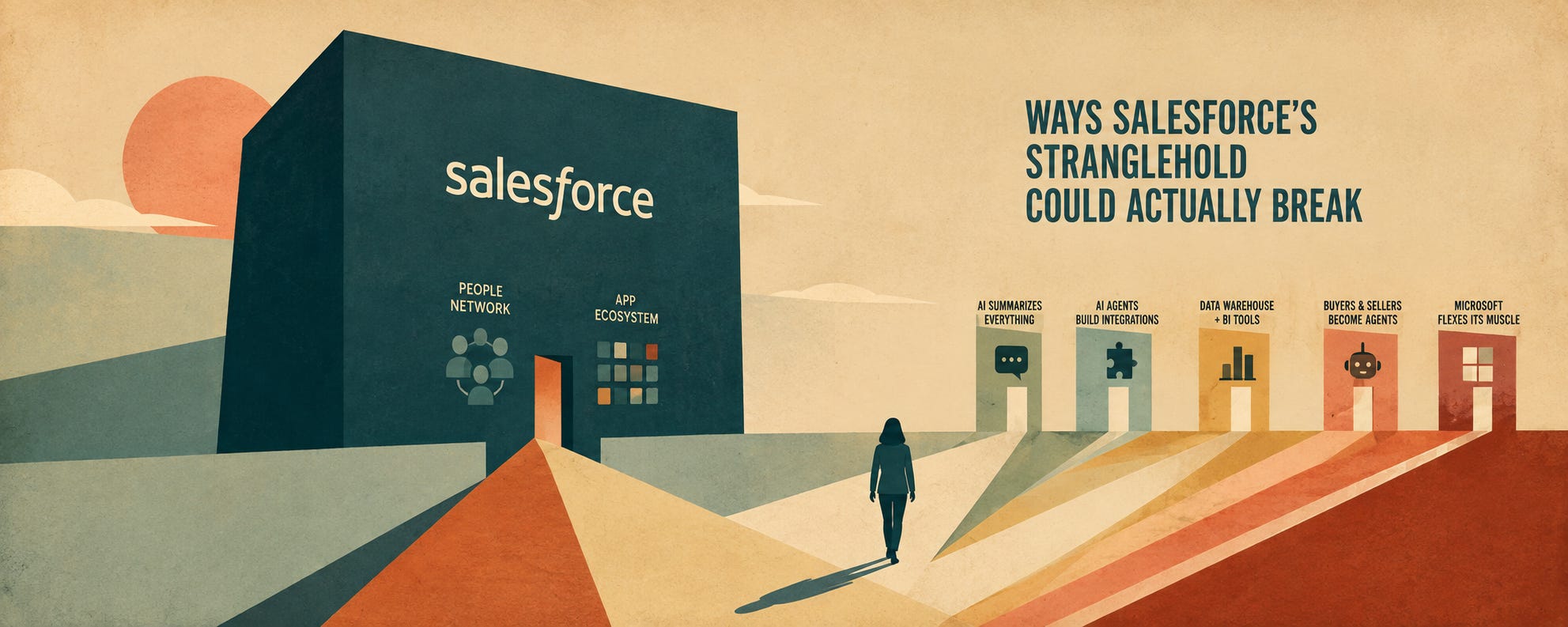
But, if AI fundamentally changes how sales works, it could get disrupted. Here are ways I think it could happen:
The corpus of customer exchanges becomes the record
The CRM was there as a way of summarizing what has happened with the customer, because each time you needed to understand that customer relationship, you couldn’t just re-read every piece of history with the customer. That summarization is paid for in human time: by Salesforce’s own State of Sales research, reps spend about 70% of their week not selling, and data entry alone eats close to a full day of it. But, a LLM can re-read every piece of history with the customer. So could AI replace the CRM by making that kind of summarization happen on demand?
Integrations become trivial with AI coding agents
Codex and Claude Code are already spectacularly good at writing integrations from API specs. Could they get better enough that an AppExchange with a bunch of existing integrations becomes irrelevant because integrations can just materialize on demand? This would break the AppExchange network effects, but not the labor pool ones.
Data warehouses + BI tools take over
Most enterprises have figured out that a great data strategy pays off handsomely, and the more one can centralize in the warehouse, the more powerful it becomes. Moving data to and from the warehouse is a big business in itself, but it’s plausible that an agent could let you operate out of the data warehouse and skip the middle part. No one has come close to this yet, but it could be done.
The buyer and/or the seller get replaced by agents
Over time, more and more buyers and sellers may be agents, not people. In an agent-first world, a CRM built for humans isn’t going to be the one that wins. I’m not sure what the agents will want to use, but it’s probably not the Lightning UI in Salesforce.
Microsoft flexes its muscle
A weaker version of any of the scenarios above, combined with Microsoft using its distribution, bundling, and pricing power could let it overpower Salesforce.
Won’t agents always need a vault?
The information about the customer has to live somewhere - whether a human is keeping track and acting on it or an agent. So won’t Salesforce always have a place?
Yes, which is why companies already running on Salesforce will keep finding it hard to switch off; the existing business will likely be fine.
However any new agents won’t reach for Salesforce to be their database - if you need a database in the cloud, why the heck would you pick Salesforce?
Salesforce sees this coming, but that won’t be enough
Of course, Salesforce sees all this, and they won’t go down without a fight. They’ll acquire, build, and trap. But seeing it coming has never been the hard part: Kodak invented the digital camera. The problem is what fighting back costs them. Their sales channel runs through the SIs and admins who make their living on exactly the friction agents remove, so they have to sell the solvent through the people it dissolves. And their agents have to defend the object model, because that’s where the lock-in lives, while a challenger’s agents owe it nothing.
Beating Salesforce head on is not going to be possible. Whatever eventually disrupts it will win sideways, by making “should we switch to Salesforce” a question that stops being asked. Somewhere out there is the next founder at the next Freckle, and her head of sales won’t ask for Salesforce, because her head of sales won’t be a person with a resume at all. The conversation that cornered me in 2016 will simply never happen.