

I get judged all the time for loving instant coffee.1 And it turns out, the (dozens of us) other instant coffee drinkers do too: only about 11% of U.S. coffee drinkers reach for it on a given day (NCA). Why the hate?
This has been going on here a while: in 1950, a Mason Haire shopping-list study gave shoppers two identical grocery lists, except one had Nescafé. The instant buyer was judged to be lazy. Nobody sneers like that in Britain, Japan, or Australia.
And it was never really about taste. Those shoppers said it was, but blind tests from the same era showed most people couldn’t tell instant from drip. “It tastes bad” was the sayable version of “people will think I’m lazy.”
Maybe, then, Americans just have unusually refined palates, or maybe we’re a people who refuse shortcuts on principle. Neither seems likely. We invented the Keurig, which runs almost the same shortcut as instant while costing more and tasting worse. And nobody can call the Japanese unrefined: the country that perfected the pour-over also keeps a jar of Blendy in the cupboard, and nobody thinks twice (instant is about a third of Japan’s out-of-home coffee). The verdict feels like it’s coming from your tongue, but is actually coming from somewhere else entirely.
That somewhere else is the slot instant landed in when it arrived. When it came to the US, it entered a market that already had a clear idea of what coffee was, and had to compete with a product entrenched as the standard. But when it came to tea drinking countries, they didn’t have a coffee slot to compete with - it was coffee not tea rather than coffee but different.
Greece turned out to be the exception that proved the rule - it was already a coffee-first country when instant coffee arrived. Instant coffee took off anyway, because in 1957 a Nestle salesman at a trade fair couldn’t find hot water, shrugged, and shook his instant into cold water instead. It filled an empty cold-coffee slot, and Greece has been drinking his mistake ever since: the frappe is now the national drink.
When America begrudgingly accepted instant
If the incumbent decides everything, then America, a country that already knew exactly what coffee was, should have never accepted instant coffee at all. But it sort of did: it got to 17% market share in 1952 and grew a bit more in the 60s and 70s. However, this only happened because the first-wave coffee roasters destroyed the quality of coffee. When those incumbents put out a bad product, the market flirted with instant until second wave roasters put a decent cup of “real” coffee back on the table.
Choice descendants
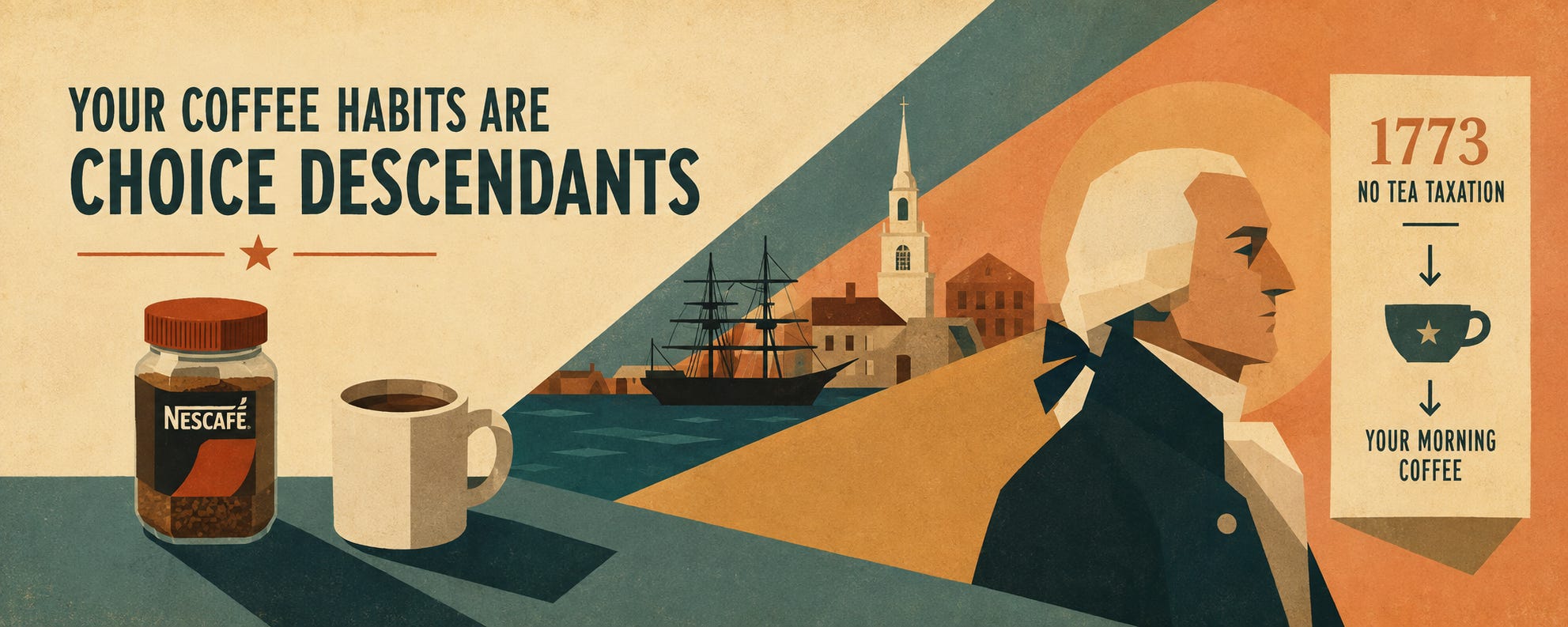
The real reason you don’t like instant coffee is because of Samuel Adams.
While Americans drank some coffee before 1773, they drank a whole lot more after tea became politically charged, and coffee became patriotic. Per capita coffee consumption soared over the decades, all kicked off by Sam Adams’ focus on tea as a constitutional test. A more accommodating organizer in Adams’ seat could have treated tea as a cheap commodity and accepted a compromise, or a less capable one could have failed to sustain resistance, or he simply could have picked a different hill.
Adams made a choice, and your dislike of instant is a descendant of that choice. Sam Adams decided you don’t like Nescafé even though it wouldn’t exist for over a century after he died.
Adams isn’t a special case. Behind a startling amount of what feels permanent, there is no law and no trend, just a person who made a call on some ordinary afternoon and then went home to dinner. Pull the thread on a taste, a habit, a border, a standard, and surprisingly often, you reach a particular choice by a particular person. Call what you’re left holding a Choice Descendant: a piece of the present that traces back to one person’s choice they could easily have made the other way. Once you have the word, you start seeing them everywhere. Ted Louckes at Oldsmobile in 1978 is the reason that Americans don’t do passenger diesel powered vehicles. Javascript is the primary language of the web despite tons of issues because Brendan Eich at Netscape had to make a bunch of choices with a tight deadline. Jack Sams at IBM neglected to demand exclusivity from Microsoft for DOS in 1980, resulting in much of the world still using Microsoft operating systems.
Their authors are long gone; the consequences aren’t. And somewhere right now, someone is making the next one on a deadline, about something that feels small, and your grandchildren will inherit it as simply how the world is.
Tomorrow at the grocery store, when you reach past the instant for the “good stuff”, notice that the thing you’re calling taste came from a 1773 argument about a tea tax that had nothing to do with coffee. Sam Adams never tasted Nescafé. And because of him you won’t bother with it either.
Try this recipe: take 2 ounces of cold milk and add instant coffee + sweetener as desired. Whip it up into a foam. Add 6 ounces of boiling water.